Thursday, 13 June 2013

Unit 4, 8,12 and 16 PASSES

Unit 4

Student Name:  Agnes  Aguilar  Corsanes

Grading
Marking Criteria
What you need to have produced
Evidenced
Put the blog / drop box / Google drive URL in the relevant box in this column
Achieved
Unit 4
P1
Describe the main job roles and functions within an organisation

Job roles in a given organisation. From entry level to the top.
Not functional areas
http://wkcagnescorsanes.blogspot.co.uk/2013/01/research-and-planning.html

Unit 4
P2
Identify different organisational structures used within business organisations
Give descriptions and images and hopefully examples of businesses that use the following organisational structures
Flat
Matrix
Hierarchical 


http://wkcagnescorsanes.blogspot.co.uk/2013/01/research-and-planning.html


Unit 4 p3


Produce the following
A)     Job description with
Job title
Pay
Hours
Duties
Who to contact

B)     Person Specification with
Essential skills and competencies (Must have to do the job)
Desirable skills and competencies (Would be considered a bonus by you)

http://wkcagnescorsanes.blogspot.co.uk/2013/01/research-and-planning.html

Unit 4 p4


Complete an application and interview for a specific job
Notes for interview suitable for application form
Interview fro one of the ones posted on blogger
http://wkcagnescorsanes.blogspot.co.uk/2013/01/research-and-planning.html

Unit 4 P5
Match current knowledge and skills to possible job opportunities using appropriate sources of information and advice
Find two jobs that you could do now –
These will probably be entry level jobs
Look at the person specification and demonstrate how you meet it.
http://wkcagnescorsanes.blogspot.co.uk/2013/01/research-and-planning.html

Unit 4 P6
Produce a personal career development plan.
This should be a ten-year timeline from now.
Either work forwards –What will you do next year etc until you reach your career goal

Or work Backwards- Think what you wish to do in ten or so years time and work backwards.
This will need research e.g.: Courses, Companies to work for experience etc
http://wkcagnescorsanes.blogspot.co.uk/2013/01/research-and-planning.html

U4 M1
This is an extension of P1
Two job roles that should be the equivalent of each other but in different sectors, or in different organisational structures.


U4 M2
A well thought out and produced job description and person specification is required.
Lots of detail such as start date, holiday entitlements etc should be included.
 You should have included all essential and desirable skills to be able to perform the job.


Unit 8

Grading
Marking Criteria
What you need to have produced
Evidenced
Put the blog / drop box / Google drive URL in the relevant box in this column
Achieved
Unit 8 P1
Identify using examples the purposes of written business communications in four business contexts
Can be internal or external context:
May be client supplier
Supplier/ client
Job application
Product info
Etc
http://wkcagnescorsanes.blogspot.co.uk/2013/06/unit-8.html

Unit 8
P2
Produce three documents
Of different types to support
Straightforward business tasks
For internal communication
In an organisation

These can be any document that may be used WITHIN an organisation: May be formal/informal depending on the purpose:
Use a Microsoft.com /word template to start you off
They should have your company logo on etc
Memo
Email
Letter
Text message
Order form
Delivery note
Agenda
Minutes


http://wkcagnescorsanes.blogspot.co.uk/2013/06/unit-8.html

Unit 8
P3
These can be any document that may be used outside an organisation: Will be informal:
They should have your company logo on etc
Email
Letter
Text message
Order form
Delivery note
Agenda
Minutes

http://wkcagnescorsanes.blogspot.co.uk/2013/06/unit-8.html

Unit 8
P4
Identify appropriate methods of communication to different audiences
You should identify when you need to be formal/informal
And what type of document would be appropriate
http://wkcagnescorsanes.blogspot.co.uk/2013/06/unit-8.html

Unit 8
M1
This is an extension of P1
Which are the right ways to communicate in different business situations
What would be the differences between a leaflet advertising a future staff party and a leaflet advertising the opening of a new branch for customers?


Unit 8
M2
What are the similarities and differences between the documents and why?
You may need to produce a letter of reply (use your U 11 letter) supported by memos to employees, a sample invoice to present to the customer.
At merit level learners are expected to produce documents that are grammatically correct, have no spelling errors and are fit for purpose.


Unit 8
M3
For example: A letter to a friend and a letter to your manager at work.
Include as many different methods as you can.


Unit 12

Unit 12
P1
Public, Private and NGO/Charity sectors need to be included
What are the aims and objectives of the site?
To educate? To sell a combination etc
http://wkcagnescorsanes.blogspot.co.uk/2013/06/unit-12-passes.html

Unit 12
P2
What are the features? Colour schemes etc
How do they achieve this? Use of Video, memberships etc
http://wkcagnescorsanes.blogspot.co.uk/2013/06/unit-12-passes.html

Unit 12
P3
Planning
Training
Costs
Funding
Hiring/ redundancies
Distribution of products to customers
http://wkcagnescorsanes.blogspot.co.uk/2013/06/unit-12-passes.html

Unit 12
P4
Risks of
Doing it
Not doing it
Fraud
Payment collection

http://wkcagnescorsanes.blogspot.co.uk/2013/06/unit-12-passes.html

Unit 12
P5
You can use template software, Dreamweaver or Publisher then save as HTML to do this.
Either post a link or take screen shots
http://wkcagnescorsanes.blogspot.co.uk/2013/06/unit-12-passes.html

Unit 12 P6
These include
24 hr business
Global opportunities
Reduced Operating Costs
Real time marketing opportunities
Increased knowledge of consumer habits (cookies etc)
http://wkcagnescorsanes.blogspot.co.uk/2013/06/unit-12-passes.html

Unit 12 P7
What are the positives and negatives to society as a whole (NOT THE INDIVIDUAL CONSUMER OR BUSINESS)
Think about employment, what is happening to shopping districts, personal interactions etc
http://wkcagnescorsanes.blogspot.co.uk/2013/06/unit-12-passes.html

Unit 12
M1
This is linked to P1
Does one of them achieve its aims and objectives better?
How and Why


Unit 12
M2
This is linked to P4
Weigh up the pros and cons of taking your business online.
Do the positives outweigh the benefits?
How and why?


Unit 12
M3
This is linked to P5
How cold a website (Yours for example) help you Make more money? Provide education etc in line with your organisational objectives?


Unit 12
M4
This is linked to P7
If Online businesses continue to grow what would the implications to society be? Good? Bad? Both? Why?
Remember to support your arguments with evidence


Unit 16
Unit 16
P1
You have given some accurate examples of how your own strengths and weaknesses could help you in preparing for business

http://wkcagnescorsanes.blogspot.co.uk/2013/06/unit-16.html

Unit 16
P2
What do the different rules and regulations allow you to do and stop you from doing?
Employment law?
Distance selling?
Race relations?
Fire regulations etc
http://wkcagnescorsanes.blogspot.co.uk/2013/06/unit-16.html

Unit 16
P3
What are the different marketing options?
See the marketing blog for more details

http://wkcagnescorsanes.blogspot.co.uk/2013/06/unit-16.html

Unit 16
P4
Where will you raise your finance?
What are the pros and cons of each
http://wkcagnescorsanes.blogspot.co.uk/2013/06/unit-16.html

Unit 16
P5
Financial aspects
Marketing
SWOT etc
Use template provided
http://wkcagnescorsanes.blogspot.co.uk/2013/06/unit-16.html

Unit 16
P6
Which individuals, Agencies and professionals can you go to here?
Parents, C.A.B lawyer etc
http://wkcagnescorsanes.blogspot.co.uk/2013/06/unit-16.html

Unit 16
M1
Extension of P1 what are the benefits to the individual (or yourself) of starting a business?
Being your own boss, Making your own decisions etc
Use examples such as Lord Sugar to illustrate your points.


Unit 16 M2
This is an extension of P2


Unit 12: Passes

P1/P2: In this task of assignment I am going to compare 3 different websites (Private Sector: H&M company, Public Sector: TFL and NGO: Barnardos Charity) regarding to their construction features.


These are the 3 websites that I have chosen: I chose H&M Company for Private Sector, TFL for Public Sector and Barnardos Charity for NGO.

Differences:
=H&M Company and TFL have got the same menu bar position but not with the website of Barnardo’s Charity.
=These 3 websites have used different colour scheme: H&M Company used black for their headings, white for their background and red colour for their logo, TFL used blue for their logo and headings and white for their background and Barnardo’s Charity used Green for their logos and headings and white for their background.
=Each website used different kind of images where they put in different positions.
=Each website has got different purposes:

-The purpose H&M Company’s website is to encourage people to buy their products through online.

-The purpose of TFL’s website is to provide daily service updates for everyone but on the other hand; their other purpose is also to make money by selling oyster/travel cards through online.

-The purpose of Barnardo’s Charity is to encourage people to help children to change their lives and also to make money by encouraging people to donate and buy their products such as cards, book, etc.

Similarities:
-These 3 websites have the same logo’s position.
-Their menu bars are on the top.
-They also have got the same main purpose this is to make money for their business.

P3: In this task of assignment I am going to explain the issues a business organisation would need to consider to go online.

If you have decided to start an online business instead of opening a business in the high street you can save money because you can reduce your start-up costs because you do not need to pay rent, licence and also you can save and you manage your own time because you can work anywhere such as at home. 

Therefore, the first step you need to do when you start doing an online business is to find website hosting but choosing which design you use will take some time and overwhelming so you must be aware of these following things.

-You need to read the rules and regulations carefully to avoid misunderstanding and trouble.

-Always ensure that your website hosting package has tools for tracking customers, where products came from and more this will help you to avoid troubles from your internet strategies.

The second step is to create your own website. There are many ways on how to make you own website which is you can hire a professional web designer who can work and apply your ideas to customize the design that you want for your website or buy a template  which is cheap and easy to use too. If you want to have another template design you can easily upgrade.

The third step is to register your online business. To register your online business as a sole trader you need to submit a paperwork which contents your Business Name, What is your business?, your county place, etc. You can download the application form from the governmental website and fill it up and filing fees range in the UK is £10-£90 depending on your county place.

The fourth step is to get business license. It is important for any business to get a government license to be able to sell products/goods and prevent trouble from any issues. It is also important if you keep informed about local laws, as you are doing online business you can call a mentor to help you to check if you meet all your business requirements.

P4: In this unit of assignment I am going to explain the operational risks for a business organisation operating online.This include website updating, payment collection, etc.

It is important for all online businesses to update their website regularly to be able to provide new updates about the product stocks, new prices, new product added and more. It is a serious problem for your business and for customers to go to see your pages which is have not been updated for a long time because incorrect and out to date information from your website can make customers' feel appalled and there is a possibility that they won't visit your web page again.

When it comes to payment collection the seller have to make sure that customers can able to pay their goods by debit/credit cards therefore the seller is also need to be careful, always keep personal details confidential and keep it in the safe place because according to the news, now days there's a lot of hackers and identity thief  who put people in trouble and steel their money in the back. To avoid these things, all online payments need to be:

-Verified by visa -Private between the customer and the seller only.
-Do not make any changes during transactions.
-Deleted from the computer when it's done and completed.

In case of order mistakes online business should have made order forms as a fool-proof to be able to decrease the amount of customer errors. The website should also made to avoid customers mistakes on purpose.

P5: In this task of assignment I am going to create my own web pages to meet a user need.
This is the website that I have done to demonstrate my creativity on how to make a website for an online business. I used baby pink as a background color and the I inserted some clip arts, images and also a drop down effect for the sub-heading.

P6: In this task of assignment I am going to describe the benefits to a business organisations of marketing a product or service online.

Running an online business have a lot of advantages such as 24 hours business, global opportunities, opportunities to monitor all business competitors, etc.

An online business website which is available 24/7 for customers which is really good for customers and for the business because there is no closing time not like shops in high streets. One of the advantages that online businesses have is that it allows customer to visit the website anytime and they can make orders anytime and wherever they are as long as they have smartphones to be able go to internet to visit the website. For an example: ASOS' website is available 24/7 for customers so, online customers can order clothes anytime they like, they can just sit down and relax because do not need to rush or anything.

ASOS needs to monitor its competitors it's either in high street or in online. ASOS team need to make a research and inform the whole team about their competitors because in this way ASOS team can get new ideas from their competitors, set new objectives and aim for the business or to create new strategies they can apply for the business to be more successful and to keep on trading. It is important to do this regularly.

ASOS is an example of an online business which is, it has got more opportunity to be part of  online advertisement such as banner ads because this is the most important way to keep on advertising and trading at the same time and this is another way to promote the business to be known of everyone in the world.

P7: In this task of assignment I am going to do an outline the impact of online business society.

In general online businesses are getting big in business society and it also has a big impact in the society, especially about employment, because a lot of people who work in store they may get fired or sacked or do a redundancy because the business is not getting enough revenue and every year is getting worse plus if they start doing online business they may not need more people to work for them because now days a lot of people just decided to purchase online because it is easier for them, it has got lower prices compare to the business in high streets for example.

Secondly, the businesses in high streets will be affected as well because 70% of shoppers prefer to order online and only 30% of shoppers still go to the store. The reason why people chose to order online most of the time is because they do not carry any shopping bags, they may get better or cheaper and sometime there are more stocks online than in store. So, it is logical, if online businesses keep growing all the stores in high streets will shut down because of bankrupt.

Unit 8: Passes and Merits

P1: In this task of assignment I am going to identify using examples the purposes of written business communications in four business contexts to get this task I am going to explain what business communication is, what The Cavendish Hotel is (the business that I chose as an example). I am also going to explain what written communication is and then I am going to explain the purposes of the written communication is and I am also going to choose 4 different scenarios which are: Job application, An e-mail to customers about the promotions, An e-mail to the business supplier and an e-mail to everyone about the menu information.

-What business communication is?

A business communication is the way how to promote the business or how to provide information about the business this could be be internal or external. 
Internal means communicating to everyone who work for the company it could be face-to-face, e-mailing or talking on the telephone with managers and staffs. External means communicating to others outside the organisation it could be talking face-to-face, sending e-mails and talking guests on the phone.

-The Cavendish Hotel

The Cavendish Hotel is a 4 Star hotel which is located on prestigious Jermyn Street, in the heart of Mayfair parallel to Piccadilly in Central London.

The hotel was established in 1966, which is considered as one of the most modern hotel of its kind at the time. It is still fitting that the hotel continues this tradition of a contemporary and stylish hotel that sits comfortably with its  history.

The Cavendish Hotel London were crowned as one of the top 100 best small companies to work in 2013 by the London Times and it was acquired by the Ascott Limited Company (1st October 2012). 

-What written communication is?

Written communication is another way to communicate to people which verbally communication is not involve. Businesses use written communication to send letters or e-mails to inform their business partners and board directors that they will have a business meeting to talk about their new business project. It can also be used to read guests feed backs and complaints which the company can read the message and can be able to reply and resolve the problem.

P2/P3: In this task I am going to describe 2 categories of business document letter (Formal and Informal) I am also going to choose 4 types of documents (E-mails, Invoice, Agenda and Minutes) that are usually used in business society. 

There are 2 categories of document in Business Society these are:


-Formal Document Letter: a formal writing style is by using a proper language (not slang), good use of paragraphs and points/ideas are clearly laid out.

-Informal Document Letter: a informal writing is by using slang words, no alignment of paragraphs and some points/ideas are mixed to another.

Both of them have their own time and place but businessmen/businesswomen should be aware of formal documents that used in business and the rules about how they are used.


I have chosen 4 types of Formal Document Letter these are: E-mails, Invoice, Agenda and Minutes. I am going to explain what are they.

  • An Invoice is a form request of payment or a bill receipt of products/services. In this form you can see the company bank details where you should put the money in. It also appears  in the slip your total amount that you need to pay and you can also see when is the due date for your payment.
Source: http://img.docstoccdn.com/thumb/orig/69578802.png

Here's an example of my company invoice:

An invoice will have the company logo on the top, company contact details, on the left side is your costumer's details and on the left side is the invoice number, date and the order number. In the middle part of the paper where you can see the name of the orders, quantity and the price. Lastly, in the bottom part of the paper you can see the subtotal, tax percentage and the final amount of your order. 

  • E-mails are very useful and easy way of communicating to others, it can be use in formal or informal situations and both of them can be in internal if it's inside of an organisation or it can be also an external if it's outside of an organisation. For example: you can use e-mails for your personal matters or business matters. However, you must have an email account and you must know your friends/relatives' email addresses (gmail, yahoo, msn account) to be able to send messages, share images, etc to your friends, relatives, family; same thing in business so also must know your co-workers/clients' email addresses to be able send your business proposals, presentations for your meeting or other important documents.

An e-mail should have the email address of recipient, subject, salutation (in the beginning: Dear Sir/Madam, Mr/Ms.), The reason why you are writing, your message, salutation (in the end: Yours Sincerely, Yours Faithfully.) and your name/signature.


Source: http://www.buzzle.com/articles/business-email-sample.html


Here's an example of how to make a formal e-mail:

"The purpose of seding e-mails is to communicate between employer and employee (business). It is free and quick, it also give you evidence of what was informed and the time of sending and receiving (reading receipt) and it all about sales figures."


  • An Agenda is a list of ideas, topics or points to be discusses at a formal meeting. You can also see and find out in the agenda how long does it take the meeting and who will be attending the meeting. It can be Internal or External document.
Source: http://4.bp.blogspot.com/-XvTfl_HtDFg/T69E1A9Wh0I/AAAAAAAAAL0/1xNa4rOfW0A/s1600/BusinessMeetingAgendaTemplate.jpg

Here's an example of my company agenda:

An agenda can be internal/external document and will have the subject, location, date, time, chair number, name of attendees, topics, decisions required, owner and time. This might be all about marketing strategy.
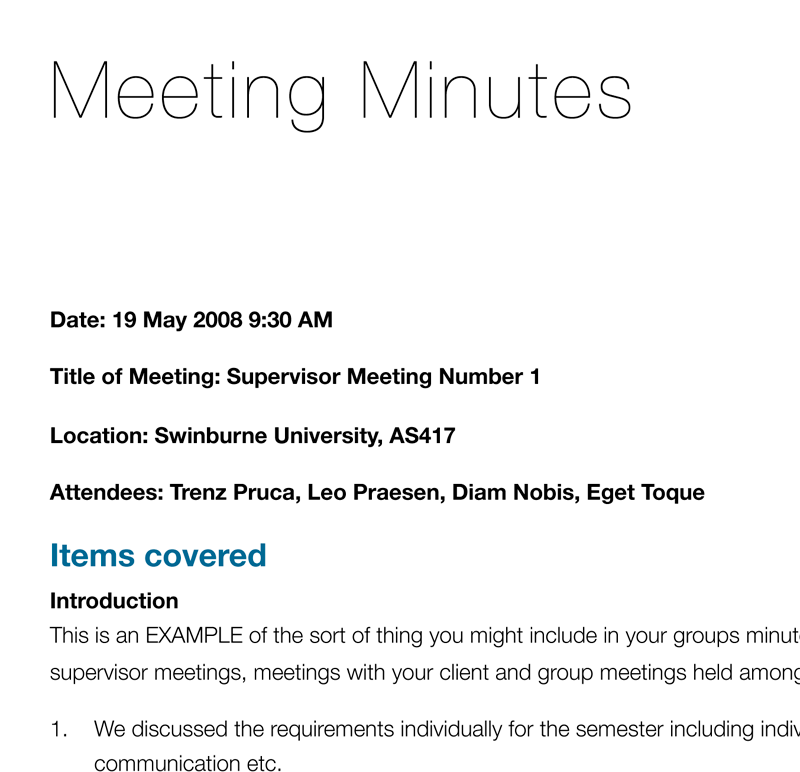
  • The Minutes of a meeting are the reports on what was been discussed and decisions that have been taken/decided. 


Source: http://mildgreenhelpliquid.com/wp-content/uploads/2011/01/Meeting-Minutes-Example.png

Here's an example of meeting minutes for my company: 


Minutes will have the date, tittle of meeting, location, name of attendees and the items covered.

P4: In this task of assignment I am going to identify appropriate methods of communication to different audiences. I am going to use an example to explain and give more details. For example: advertisement of summer holiday.

Formal language has rules on how to use it. Therefore, it can normally be used in public, news and business situations. 

Informal language has no rules strictions which means you can shorten words but never use slang words like wanna/gonna. Therefore, it can normally be used with friends, family, colleagues, etc.

For young people you can use informal language but not slang language because now days it is easy for you just to catch young people's attention if the language you use is simple words/sentences. For example to advertise the summer promotion in public which is aimed for young people, you can use new media because most of young people are using social medias, send them text messages and send them e-mails because most of young people have smartphones which is they can check their emails anytime and there is possibility that you can get their attention by sending them e-mails with images, or you can also give them flyers/leaflets or posters but the less chance you catch their interest and attention because now days young people are not bothered to read what's on the paper, what they normally do is look at the picture and the design if they like it they will keep it, if not they will just throw it in the bin.

For elderly people you must use formal language because it is important that you use proper words or sentences whenever you talk to old people it is either in personal or through written communication so, they can easily understand things and it is also a way of showing respect because most elderly people are quit sensitive they always want proper details and proper explaination in everything, especially when you are advertising a travel for summer holiday. There are many ways where you can inform them about the promotion such as new media because they are more often watching TV so, there's a possibility that they see the advertisement and may be interested but this is based on contents of the advertisement because they may get offended.

M1/M2/M3: In this task of assignment I am going to describe methods of written communication in different business contexts. Secondly, I am going to compare and I will be talking about similarities and differences between an internal and an external document. Lastly, I am going to describe appropriate methods of written communication to different audiences. I am also going to use an example which is a letter for a family member and a letter for my manager at work.

Communication means exchange of words of mouth (information and ideas). 

There's a lot of methods that can be used to be able to communicate with others, specially in business organisation. It is also important to each and everyone that they know which language are they going to use when they talk to people, it's either formal or informal.

Different methods of communication

1.) Verbal Communication: This method is usually can be used in face-to-face (e.g business meeting) because it is easier to explain things if you see the person that you are communicating with because it helps you to observe and see their body language if they are interested.

Keep on your mind that whenever you use verbal communication with others, be careful of your voice speed and tone. Try your best to avoid yourself to speak with your angry tones and control yourself speaking like you are defensive. Therefore, if you are doing a presentation in front of the team, make sure that you speak clearly and loudly so they able to hear and understand you.

As a conclusion verbal communication is the best method that you can use in business because you can discuss this more in details and an able to show examples if necessary. 

2.) Written Communication: Now days, this method of communication is everywhere, especially in the workplace (e.g e-mails, letters, reports, etc) and other written documents are part of business life. This way is very convenient for everyone because you can explain or give proper detailed instructions. For example, if one of the managers went to another place to visit other shops it is easier for the manager to write a letter to inform her/his supervisors on what they should need to do next while she/he is far.

Email is a time saver for everyone, especially in the workplace. If you rely on e-mails and memos to conduct the business, it is important to insert a proper image and never use abbreviations. Always check your spelling and read the message all over again to assure that it is not confusing. Always remember that e-mails should be brief but straight to the point.

3.) Non-Verbal Communication: This method of communication is very hard for most of everyone, it plays a big role n the way you communicate with other people. Unless you are using sign language and other people understand what does it mean. 

Always remember that you need to be aware of everything around you including your gestures, eye contact and body language because it all convey a message to the person that you are talking to them.

I am also going to use my e-mail response for the customer's complaint as an example of written communication. I used formal language to show to the customer that I care about what happened and I am willing to fix it as soon as possible.
"As a conclusion of this assignment in my opinion you just need to be careful of which language you use to communicate with others because you may hurt other's feelings and they might get offended. Always think first before you say things."